Description of the test
The prostate gland produces seminal fluid, which is the liquid part of semen. It also produces a protein called prostate specific antigen (PSA). The PSA test is used to determine your level of PSA.
Most men have some PSA in their blood. Finding a high level of PSA may mean that the prostate gland is enlarged, infected, inflamed, or cancerous.
Testing normally occurs in a clinic, at a doctor's office, or in a hospital.
How often should the test be performed?
You and your doctor will determine how often to perform this test.
PSA testing may be suggested to monitor the progression or the response to treatment for prostate cancer.
Currently, routine PSA testing to screen for prostate cancer is not recommended for all men because experts do not know if the benefits of testing outweigh its risks. When PSA testing is done, it is often in combination with a digital rectal exam (DRE). If test results indicate that prostate cancer may be present, more tests (e.g., biopsy, ultrasound) are needed to make the diagnosis.
Screening with PSA testing is limited by the fact that it has a high false positive rate (i.e., tests results suggest cancer, even though cancer is not present), leading to unnecessary anxiety. It can also lead to further unnecessary testing, which can lead to complications such as sexual problems and problems with urination.
PSA testing is also associated with a high false negative rate (i.e., test results suggest no cancer, but cancer is actually present). Even if PSA testing leads to the diagnosis of prostate cancer, the cancer may be very slow-growing and may not have caused significant problems for years.
Also, it is not known whether PSA screening saves lives. Research is ongoing to determine the risks and benefits of PSA screening.
Because of the limitations of PSA testing, men should discuss with their doctor the pros and cons of PSA testing and whether PSA testing is right for them.
Why is this test performed?
Your doctor may suggest this test to monitor prostate cancer or to monitor your response to prostate cancer treatment.
PSA testing may also be used to screen for prostate cancer, but there is much controversy around this (see "How often or when with this test be done?"). Talk to your doctor about the pros and cons of using this test to screen for prostate cancer.
Are there any risks and precautions?
Although the PSA test is considered safe, it does have some risk of side effects or complications. Though rare, the side effects or complications may include:
- infection (if the area is not properly sterilized before the sample is taken)
- excess bleeding from the puncture
- bruising where the needle was inserted
- fainting or feeling lightheaded
People with bleeding disorders or anyone taking medication that reduces the ability of the blood to clot (e.g., warfarin, acetylsalicylic acid (ASA), or other anticoagulants) should tell the technician before the blood samples are taken. These conditions and medications may require special attention at the time of testing.
If you are concerned about any symptoms following this test, speak to your doctor. Take the time to be sure you understand all the risks of complications and side effects as well as any precautions you or your doctor can take to avoid them. Be sure your doctor understands all your concerns.
What happens during the test?
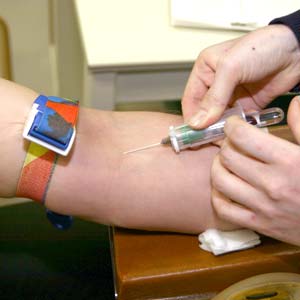
Blood is collected into one or more small vials labelled with your information.
The technician should wear fresh latex gloves and use a new, single-use needle for each procedure.
- A technician or nurse wraps a wide elastic band around your upper arm to help locate the vein.
- Once the vein is located, usually on the inside of your elbow, the area is disinfected using alcohol swabs.
- The technician inserts a needle into a vein and pushes a vial onto the needle to collect the blood.
- The elastic band is removed and after the blood is collected, the needle is removed and discarded.
- You will have to hold a small piece of cotton over the area until bleeding stops. A small bandage will be applied to hold the cotton in place.
The test is almost painless for most people, although you may feel a slight pinch when the needle is inserted. The vials of blood are then sent to a laboratory for analysis.
How should I prepare for this test?
Before having this test, discuss the advantages, disadvantages, long-term risks, and consequences associated with the test with your doctor. Be sure you fully understand what will happen and are comfortable with your doctor's answers to your questions.
Before having a PSA test, you need to avoid sex and sexual activity for 24 hours. Waiting until certain infections go away is also important (e.g., urinary tract or prostate infections). Let your doctor know if you've had a prostate examination or DRE in the past several weeks.
If you have had a recent cytoscopy (a procedure that evaluates the urethra and bladder using a thin tube with a camera), it is recommended that you wait a few weeks before doing a PSA test to get the best results.
Tell your doctor or prescriber about all prescription, over-the-counter (non-prescription), and herbal medications that you are taking. Also tell them about any medication allergies and medical conditions that you may have.
Ask your doctor or pharmacist whether you need to stop taking any of your medications before the test.
What can I expect after the test?
Some people experience slight bruising or tenderness at the site where the needle enters the vein. Keeping pressure on the area after the needle is removed helps prevent bruising.
Results
Normal values for the PSA test depend on what the laboratory and doctor consider normal. Some doctors use age-specific ranges to compare results while others use the same range for all men regardless of age. The units of measurement are nanograms per milliliter (ng/mL).
A high PSA level may be a sign of prostate cancer. However, your PSA level may also be high due to other conditions of the prostate gland, including inflammation of the prostate (prostatitis) or enlargement of the prostate (a noncancerous condition).
Other tests such as a biopsy (taking a tissue sample from the prostate with a needle) are needed to confirm whether you really do have prostate cancer. Talk to your doctor about the risks and benefits of further testing.
If the PSA level has been tested several years in a row, an increase might be considered important even if the level is not very high, particularly for men at high risk.
Men who have had treatment for prostate cancer sometimes have their PSA level checked regularly. An increase could be an early sign that the cancer is coming back.
All material copyright MediResource Inc. 1996 – 2024. Terms and conditions of use. The contents herein are for informational purposes only. Always seek the advice of your physician or other qualified health provider with any questions you may have regarding a medical condition. Source: www.medbroadcast.com/procedure/getprocedure/Prostate-Specific-Antigen-Test