Your baby has sunburn if you notice skin that is pink or red, warm, painful,
and with or without blisters. Sunburn symptoms may not start for two or more
hours after the sun damage has occurred. Once you have determined that the baby
has sunburn, your goals should be to stop the burning and treat the burn.
Tips
- Stop the burning! Get baby out of both direct and indirect sunlight.
- Either put the child in a cool bath or wrap in a cool wet towel. Do this
regularly, especially in the first few hours. This may help reduce the depth
and extent of the burn.
- Use pediatric acetaminophen or ibuprofen for pain relief.
- Try oatmeal (Aveeno Colloidal Powder) or baking soda in the bath to reduce
discomfort.
- Use an antihistamine to reduce itchiness. Do not administer antihistamines
in children less than 6 months old without first consulting your family doctor.
- Do not apply butter, lard, margarine, vitamin E, petroleum jelly, honey,
warm water, tea bags or sunburn anesthetic sprays to sunburned skin.
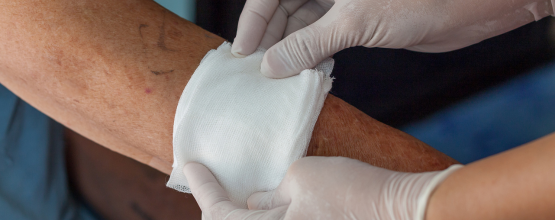
- Wash blistered areas daily with mild soap and water, pat dry and cover with
an antibiotic ointment and a dry sterile dressing.
- Children need protection from all aspects of the sun: use eyeglasses, hats,
sun blocks for noses and lips and appropriate clothing. Parents are role models
for proper skin care; be a good example.
- Use sunscreens that block both UV-A (the skin-damaging rays) and UV-B (the
skin-burning rays). Reapply sunscreens regularly (approximately every 2 hours).
Reapply sunscreens more regularly if child is swimming or sweating. Try the
new "waterproof" sunscreens.
- Sunscreens are needed during all four seasons!
- Apply the sunscreen 20 minutes before baby is to go outside. Avoid having
children outside between 10 am and 2 pm (when sun's rays are the strongest).
Replace your sunscreens yearly.
Case study
Jody was 11 months old when she was brought in to the office.
"We were at a family picnic yesterday and she somehow got a sunburn on her
arms and scalp," explained her mother. "She spent the day on a blanket underneath
a tree so I didn't think she needed any sunscreen. I tried to keep her hat on
but she just kept pulling it off. The only time she was actually out in the
sun was when the relatives were passing her around. I feel terrible, she was
whining all night and wouldn't eat her breakfast this morning."
Examination revealed a girl with good hydration but a first-degree burn to
her scalp, arms and legs.
Jody had her first sunburn.
Take baby to your family doctor or to the emergency department immediately
if you see any of the following:
- extensive burns
- skin blisters or open sores
- fever greater than 38.5°C (101.3°F)
- headaches
- excessive sweating
- fainting spells
- skin that looks infected
- baby looks or acts sick
- signs of dehydration
- vomiting
Trade secrets
- The best treatment for sunburn is prevention, especially in babies.
- Infants, with their thin skin, are at increased risk for burns.
- First- and second-degree burns rarely leave scars.
- To heal without scarring, prevent the burned skin from getting infected.
- Pain usually lasts for the first 48 hours. Skin peeling usually occurs within
seven to 10 days of the burn.
- Burning causes dehydration, so encourage your child to drink more fluids.
- The risk of malignant melanoma doubles with each blistering sunburn.
- Infants, with their reduced ability to sweat and control their body temperature,
are at increased risk for heat exhaustion and heat stroke.
- The skin is red in first-degree burns.
- The skin has blisters in second-degree burns.
Definitions
- SPF (Sun Protection Factor) is a rating scale for the protection ability
of sunscreens. SPF-15 gives you 15 times as much protection as your natural
skin coloring.
- Sunburn is the burning of the skin, lips, etc., as a result of excessive
sun (ultraviolet light) exposure.
- Other words for sunburn are burned, burnt, cooked, fried, lobsterized,
scorched, or roasted.
Medications and treatments
- Lip balms with UV protection.
- Sunscreens with UV-A and UV-B blocking (e.g., Ombrelle, Photoplex,
PreSun). Purchase sunscreens with an SPF designation of 15 or higher.
- Zinc creams are excellent for protecting noses, lips, and tips of
ears.
- Ibuprofen (e.g., Infant Advil, Infant Motrin) may both treat the
pain and reduce the depth or extent of the burn by reducing skin inflammation.
- Antihistamines (e.g., Benadryl, Claritin) are used to reduce the
discomfort of itch. Do not give antihistamines to children less than 6 months
old without first consulting your family doctor.
Excerpt from Your Home Doctor - Babies by
Robert Fallis, MD, CCFP,
in association with MediResource